LA HORDE (2009)

LA HORDE (2009)

LA HORDE is set in one of the Grand Ensemble buildings. These are the tower blocks in the Paris suburbs and were the modern housing solution for this city and much of the rest of the world during the 1950s, 60s and 70s. They significantly transformed the urban, suburban and rural landscapes, and shaped and formed the way that people lived – the deleterious effects of which are still being felt today. The blame for the Grand Ensemble, and its grim environment, is often placed, either fairly or unfairly, at the feet of the highly influential architect Le Corbusier.

The tower block in LA HORDE is abandoned, that is for the most part. A few residents remain and there is a sort of building guard – a kind of heavily armed concierge. This Grand Ensemble was built, we are told during the film, 30 years ago, in the late 70s. One of the remaining residents remarks that his wife never liked it there, but he did. As it was a constant fight for survival, like when he fought in the war in Indochina, he tells us. 

The Grand Ensemble is the Horror house in this film. 

LA HORDE, opens in a cemetery. At the funeral for a policeman, friends and colleagues plan to go to the Grand Ensemble to seek revenge upon the criminal gang responsible for his death. In this film, as in many, there are good characters, bad characters and in between characters. Here the in between characters are those with a broken heart and so, either easily led, or alternatively emotionally distant to avoid further heart break. The police woman character states at one point:  “You can shove your apology up your arse. I don’t owe anyone anything. I don’t give a shit about you. I don’t give a shit about Ouessem*. I don’t give a shit about anything.” But this is a sub-plot. The most important thing is to get out of the Grand Ensemble alive. We’ll hear from her again later. 

In we go. In a bungle – once the police find the criminal gang – the gang manages to capture all the police in one tiny room within an apartment. After some violent interaction it becomes apparent that there is indeed a greater threat. Zombies. 

The police and gang lose their number and eventually form a team. Having expelled the Zombies from the Grand Ensemble, and now inside the Indochina war veteran’s apartment, the group takes time to reflect. Looking out the window and across the suburbs to the city of Paris, Bola, who’s from Nigeria states: “This looks like Abuja”. 

Also in looking out the window we see there are thousands, perhaps millions of Zombies. The threat, now that the Zombies have been expelled, is coming from outside  from where the ideas for this vast housing scheme were hatched. The people destined to live within the grand emblems in the suburbs where not consulted. The people responsible for implementing these ideas never saw themselves living here.  

In getting the TV to finally work, there is news that the city has been cordoned off and a military zone created where, if you can get to it, you’ll be safe. In hearing this Bola’s brother states that it is typical that the city has taken care of itself and abandoned the suburbs.  (In Paris the city and suburbs are significantly split between rich and poor. {This over simplifies a complex situation but indicates a truth with some geographic reality.}) 

No one in this film really connects. The architecture of the grand ensemble won’t allow for it. This building typology was a terrible idea, that didn’t work for out well for many, the film suggests (see also La Haine 1995, for example).  

In the film there are groups within which there is some sort of connection. In the beginning the groups are police and criminals. Later, these groups merge and are joined by the racist Indochina war veteran. But none of the individuals really connect with each other on a personal level. And further, when this new group later splits, Bola and his older brother end up totally disconnected being on opposite sides.

All through the film there are juxtapositions of them and us / us and them created by boundaries and borders both physical and intangible: being either inside or outside of the group, the building, the city. The Grand Ensemble towers in their urban form alone create a strong demarcation between the suburbs and the much denser and lower urban fabric of the centre of Paris. The Boulevard Périphérique around the centre of Paris is a physical boundary which for the most part appears as an elevated highway.  It carries heavy traffic, and is like the old city wall with its gates there are specific points around it through which you can enter and exit.

LA HORDE seems to suggest that an urban environment has been created in which it is impossible to connect, except perhaps for those who live inside the Boulevard Périphérique, in a “dreamworld**” which as this phrase suggests has its limits.  The city has been reduced to a military base which like the Grand Ensembles, is a controlling and controlled environment. We’re all in it together. No one escapes. 

*Ouessem is one of the police-woman’s colleagues, one of the central characters in the film.

** See the introduction to “Evil Paradises: Dreamworlds of Neoliberalism” eds. Mike Davis & Daniel Bertrand Monk

Louise Mackenzie 2015

A SHORT ARCHITECTURAL FILM PROGRAM

THE MADA SHORT ARCHITECTURAL FILM PROGRAM 2014: PROGRAM NOTES

ARCHITECTURE & FILM

The exploration of the lived experience of the city through cinematic constructions is one of the many possible approaches to the study of film and architecture. Storytelling is a significant key in understanding aspects of architecture and the city. The possibility of narrative within film activating unspoken narratives of architecture and the city provides exciting opportunities for understandings the city in terms of our relationship to it through our senses and, the material and immaterial aspects of experience.hugo 01

Image credit: HUGO still (2011) Martin Scorsese

# # #

CARS CINEMA CITY

This image above is a still from HUGO, the Martin Scorsese film of 2011.It makes a useful reference point in thinking about the inter-relationships between film and architecture. This image, the particular still, and the context from which it is taken, the film HUGO, points towards many of the themes which are explored through this program of short films: modernity, the city, transport, home, the constant inter-change between the real and fictive and the cinema itself.

# # # 

MODERNITY 

The still contains much in terms of cinema history too. In the background, the black and white part of the image, what we are seeing is a part of one of the very first films ever made and screened. It’s from 1895 and it’s called L’ARRIVÉE D’UN TRAIN EN GARE DE LA CIOTAT (THE ARRIVAL OF A TRAIN AT LA CIOTAT STATION). It runs for less than a 1 minute, about 50 seconds.

The people we see in colour at the front of the HUGO still are a part of an early film history/ myth often referred to but apparently not readily confirmed. That is, the people watching the film in these early screenings thought the train was going to come of the screen and hit them[1]The train and the cinema are both marvellous 19th century modern phenomena (marvellous:  as in things marvel at people).

Image creditL'ARRIVÉE D'UN TRAIN EN GARE DE LA CIOTAT  still (1895 or 6 or 7 ) Lumiere Brothers

Image credit: L’ARRIVÉE D’UN TRAIN EN GARE DE LA CIOTAT  still (1895 or 6 or 7[2]) Lumiere Brothers

# # # 

PARIS

The film HUGO, the context from which this still is taken, is a weird a sort of film, when you stop to think about it, but it’s a type we readily accept from Hollywood.Image credit HUGO still (2011) Martin Scorsese 02

Image credit: HUGO still (2011) Martin Scorsese

HUGO is set and partly filmed in Paris; it’s made by an American director, with most of the star cast being English and it is an English language film – not a French film.

The story, time wise, is set in the 193os. The film is telling, in relation to what we know of Paris historically from this period, for what it leaves out and for what it includes. Part of the film’s workings in telling its particular story – of Paris, is that it is not so much a story of the people of Paris, the people who live there and experience this city as home; but it is a very particular view drawn from another modern phenomenon that of mass tourism.

This view of Paris, in the film HUGO, is one that belongs to those who travel to, or wish to travel to Paris. This view is a part of the imagery embedded within ideas of both the real and the fantastic which has drawn in us…and artists and writers, in large numbers, typically to places such as Montmartre in the 19th century and later to Montparnasse  in the early part of the 20th century; and this is when and where the film HUGO is set, specifically it is set in the train station Gare Montparnasse. What’s left in the film HUGO is, a romantic, outsiders view of Paris, one that possibly really only fully exists in our ideas and images, in our minds, in postcards, in stories told to us, in films, in fleeting visits; but it is a Paris that is perhaps no less real than the Paris that we touch with our feet (for us as people who don’t live in Paris, but dream about and travel to it) this is for us – Paris.

# # # 

MODERN ARCHITECTURE

So what’s left out, amongst other things, is any reference within the film to the modern architecture of the 1920s and 1930s; the period in which this film is set.  

In 1924 the film L’INHUMAINEwas released. The exterior sets are designed by the architect Robert Mallet Stevens, a contemporary of Le Corbusier. The film suggests that modern architecture is the way of the future. It suggests the very urban fabric of Paris that HUGO romanticizes is redundant.

HUGO shows none of the work of Le Corbusier or other modern architects of this period, even though the film itself, as noted, is saturated with other elements of modernity. The film appears as if in a sort of bubble, as all films are to a certain extent. 

 [left] Image credit L'INHUMAINE  still (1924) Robert Mallet Stevens set design (Film set filmed in Paris)

Image credit: L’INHUMAINE  still (1924) Robert Mallet Stevens: set design (Film set/filmed in Paris) 

[right] Pavillon de L'esprit Nouveau (1925) Le Corbusier The International Exposition of Modern Industrial and Decorative Arts    

Image credit: PAVILLON DE L’ESPRIT NOUVEAU (1925) Le Corbusier: The International Exposition of Modern Industrial and Decorative Arts (Held in Paris April to October 1925)

Martel House (1927) Robert Mallet Stevens Paris 16th Arrraodisment

Image creditMartel House (1927) Robert Mallet Stevens Paris 16th Arrraodisment 

# # # 

The TRAIN STATION …and later The CAR

The station of Gare Montparnasse, the old one from the 1840s, subjected to a 2nd wave of Humanisation, was demolished and replaced in 1969 with the station we see today.

gare m

Image credit:  Gare Montparnasse   

 gm 2                     

Image credit: Gare Montparnasse   

gm 3                                 

Image credit: Gare Montparnasse                                

The Gare Montparnasse itself plays a major role in the film HUGO as it does in the city of Paris. It was  originally one of Paris’ six major entry points to the city by steam train and as such it is a part of the modern journey, not only for tourists, but essentially in terms of the history of the modern city, for the mass migration of people from the country to the city. 

The first steam train in Paris built in 1830s ran from what is now Gare Saint-Lazare  to east of the city beyond the periphery allowing the middle classes to live in the suburbs outside the city and travel in to work.  The subsequent train lines played a significant role in shaping the whole city especially in relation to housing and work, as the car did in the decades after world war two, some of the effects of which we are still living with and searching for solutions to today. 

# # # 

HOME

Home is pictured in various ways throughout the film HUGO, such as: the boy character, Hugo, left abandon – who lives in the clock tower and within the walls of the station Gare Montparnasse;  and there’s the loveless home of the institutionalised station master,  also located in the station;  and the Méliès sad home, of a marvellous life lost (marvellous: as in “extremely good or pleasing; splendid”)[3].

The last home is depicted through a classic Paris imagery. And each of these Parisian characters, played by non-Parisians,  are at home in the city, in this fictionalized, romantic version of Paris we still encounter the characters as rooted to some place  – we know  to be there.

Image credit HUGO still (2011) Martin Scorsese 03

Image credit: HUGO still (2011) Martin Scorsese

# # # 

The REAL AND FICTIVE

This film is a cleaver play of the real and fictive.  Mixing real events and buildings with dreams, which in part at least, play a role in exploring the realness of what Paris means to us, the ideas we have about it when we picture it, the ideas we have about it when we experience it on the ground.

The film HUGO depicts an event from 1895.  A train overran the barrier at Gare Montparnasse – it came through the front of the station and ended up on the street.  This event appears in the film, set in 1920s as noted, in the boy Hugo’s dream.

The film plays further between the real and fictive in the representation of the Station. The exterior of the station depicted in the film is similar but not the same. This blurs the boundaries and plays a part in making connections between the real and the fictive between as Lorraine Mortimer puts it the “document and fiction[4]” she suggests, between the magic of the cinema…and life.

Image credit HUGO still (2011) Martin Scorsese 04

Image credit: HUGO still (2011) Martin Scorsese

Image credit HUGO still (2011) Martin Scorsese 05


Image credit: HUGO still (2011) Martin Scorsese

gare m train crash 01


Image credit: Gare Montparnasse  (1895)                              

gare m train crash 02

Image credit: Gare Montparnasse (1895)  Photo by Studio Lévy & fils.  

gare m train crash 03 set

Image credit: On the set of HUGO (2011) Martin Scorsese

# # # 

The CINEMA

At the heart of the story of the film HUGO is Georges Méliès who while the Luminaire Brothers made “actualities” such and “A Train Arrives at the Station” he was one of the first people to bring fiction to film, beginning in 1896.  He made fantasies and sci-fi movies  – “A Trip to Moon” being one of his most famous. 

G MEL STILL

Image credit: LE ROYAUME DES FÉES (1903) still Georges Méliès [The Fairy King]

G MEL STILL 02 hUGO

Image credit:  HUGO still (2011) Martin Scorsese

REFERENCES

[1] Loiperdinger, Martin,  Bernd Elzer.  “Lumiere’s Arrival of the Train: Cinema’s Founding Myth”The Moving Image 4.1 (2004) 89-118

[2] Loiperdinger, Martin,  Bernd Elzer.  “Lumiere’s Arrival of the Train: Cinema’s Founding Myth”The Moving Image 4.1 (2004) 89-118

[3] http://www.oxforddictionaries.com/definition/english/marvellous?q=marvellous

[4] Lorraine Mortimer Terror and Joy: The Films of Dusan Makavejev  University  of Minnesota Press:  Minnesota, 2009. Page 131

9 JUNE 2014_LOUISE MACKENZIE

A SHORT ARCHITECTURAL FILM PROGRAM

Wednesday 09 July 2014 @ 12.30PM

Wednesday 03 September 2014 @ 12.30PM _ to be confirmed _ stay tuned

A SHORT ARCHITECTURAL FILM PROGRAM WEEK [05]: THE CITY & THE SUBURB SPOTSWOOD [FILMS: HARVEY KRUMPET / CITY: MELBOURNE]

Guest speaker: TBA

The Suburb, a modern phenomenon, the context in which this film is set. The attention to detail of the urban fabric in this Oscar wining claymation is telling. HARVEY KRUMPET…Spotswood in detail…Harvey’s life told…

Wednesday 2014 @ 12:30pm / MADA Gallery Building G Caulfield Monash University 

Film: Harvey Krumpet by Adam Elliot 2003 (23mins)

A SHORT ARCHITECTURAL FILM PROGRAM

Wednesday 02 July  2014 @ 12:30PM

A SHORT ARCHITECTURAL FILM PROGRAM 

WEEK [04]: CARLTON & THE FRENCH NEW WAVE / LOOKING BACKWARDS & FORWARDS 

[FILMS: The Girl Friends, Secondskin, Subterranea & 57 Spring Street / CITY: Melbourne]

Guest speaker: Louise Mackenzie

In the late 1960s and early 70s in Carlton, Melbourne, there was a bunch of films being made that were unashamedly frenchnewwaveques…made cheaply mostly by students this body work seeded the renaissance of the Australian film industry. THE GIRL FRIENDS being made in the nineteen sixties indicates, in looking at Carlton today, the massive changes that have taken place since and where taking place at the time the film was made.  The next three films are from The Cinecity Project and suggest change as well  – places lived in, some abandoned and some regained, some with adjusted uses, some enabling ways of life lived, some thinking back and moving on.

THE GIRL FRIENDS (1968) Carlton, Melbourne…commission flats…terrace houses…the nineteen sixties _“These boots were made for Walking”… and dancing…    

SECONDSKIN (2009) Once was home…home again      

SUBTERRANEA (2010) Car parks…as art spaces…as film space as art                      

57 SPRING STREET (2013) Cinematic long section of a life in place in time

Wednesday 02 July 2014 @ 12.30pm / MADA Gallery Building G Caulfield Monash University 

Film: The Girl Friends by Peter Elliot 1968 (25mins)

Film: Cinecity: Secondskin by Georgia Forbes & Lisha Corcoran 2009 (1mins)

Film: Cinecity: Subterranea  By Lindy Fetherston 2010 (1mins)

Film: Cinecity: 57 Spring Street By ShMoJo 2013 (1min)

A Short Architectural Film Program_Week 4_Carlton and The French New Wave

A SHORT ARCHITECTURAL FILM PROJECT

Wednesday 25 June 2014 @ 12:30PM

WEEK [03] PARIS: THE FRENCH NEW WAVE – – – AND very FAST CARS

[FILMS: PARIS VU PAR: GARE DU NORD & C’ÉTAIT UN RENDEZ-VOUS  / CITY: PARIS]

Guest speaker: Helen Runting Urban Planner & Designer KTH School of Architecture in Stockholm

These two films in their juxtaposition explore ideas which touch upon the experience of living in Paris during this period of rapid modernisation (often referred to as a second Humanization of the city). Paris at this time was not only reshaped by modern architecture – there was also a new affluence and a new freedom a new pop culture to be experienced. The two films raise questions about transport and how it shapes the city.

GARE DU NORD  by Jean Rouch: The French New Wave directors of the 1960s took their handheld cameras into the streets and it is this which contributes to Paris itself playing a role as main character in this body of film works.  GARE DU NORD  explores much of the modern experience in the second half of the 20th century in Paris. Demolition…construction…boredom…a tiny flat…in Paris!! … A train station / a bridge.

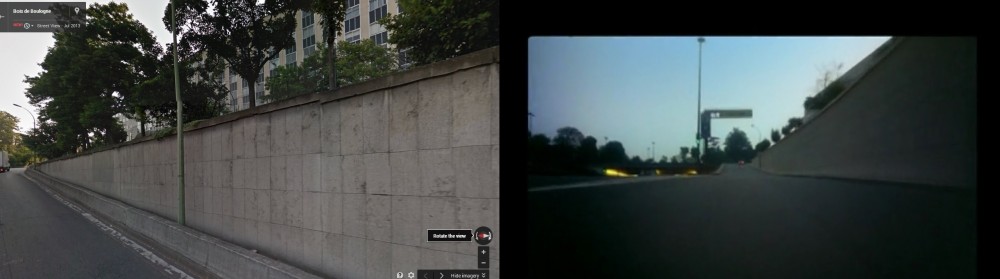
C’ÉTAIT UN RENDEZ‐VOUS by Claude Lelouch  made a decade later, is a classic single take film, which amongst other things talks about transport and the city  [the car only becoming affordable is this post war modern period] – the film has a strange mix of contractions  – it begins just on the periphery near to where Le Cobusier worked and lived – it suggests a possibility but one that is only allowed due to a given circumstance – Just before dawn…one Paris morning…one fast car…it was a meeting.

Film: Paris Vu Par: Gare du Nord by (1964) Jean Rouch  (20mins).

Film: C’était un rendez‐vous (1976) by Claude Lelouch  (9mins)

Wednesday 25 June 2014 @ 12:30pm / MADA Gallery Building G Caulfield Monash University

PARIS VU PAR: Six short films made in specific neighbourhoods of Paris by Six different French New Wave directors.
JEAN ROUCH: Is not strictly thought of as a New Wave director but you can see the connection between his work and theirs.  He made CHRONICLE OF SUMMER in 1960 with Sociologist and film lover Edgar Morin. It’s an ethnographic film made in Paris.
GARE DU NORD: [Station of the North]one of the six main train stations  in the city, which in the 19th century  where the  major gate ways to Paris,  with their curious and wonderful mix of grand civic fronts and shed type backs.
C’ÉTAIT UN RENDEZ‐VOUS: [It was a meeting]
CLAUDE LELOUCH:  http://www.imdb.com/name/nm0500988/


A Short Architectural Film Program_03 PARIS THE FRENCH NEW WAVE _ _ _ AND very FAST CARS 25 June 2014 


A SHORT ARCHITECTURAL FILM PROGRAM

A SHORT ARCHITECTURAL FILM PROGRAM

Week [02]: MODERNITY 20-60 PARIS & LOS ANGLES: LE CORBUSIER & CHARLES & RAY EAMES:

[FILM: BATIR – THE POWERS OF TEN / CITY: PARIS – LOS ANGLES]

This weeks screening will be followed with a discussion by STUART HARRISON

 It’s not quite the classic 20-60 split but both these films show different but related modernities. This week 1930s modern architecture in the film BAITR, directed by Peire Chenal with inter-titles by LE CORBUSIER is juxtaposed with the work of post war modern Californian architects and film makers CHARLES & RAY EAMES. BATIR and Le Corbusier speak in reference to the future using the new – new construction methods, new building types, new materials and what this will bring, new better ways of living. THE POWERS OF TEN (1977)  set in a park in Chicago, another great modern city, via  suggested camera movements asks questions about scale and context, our place in the world and the worlds within us.

[This week could be viewed in some ways as from “Functionalism” to what Peter McIntyre may call “Emotional Functionalism” at global and personal scale.]

 Wednesday 21 May 2014 @ 2pm / MADA Gallery Building G Caulfield Monash University

WEEK [02] MODERNITY 20-60 _ LE CORBUSIER & THE EAMES

A SHORT ARCHITECTURAL FILM PROGRAM

A SHORT ARCHITECTURAL FILM PROGRAM

Week [01]: MELBOURNE HOUSING THEN & NOW

[ FILM: YOUR HOUSE AND MINE / CITY: MELBOURNE ]

In this week MELBOURNE HOUSING THEN & NOW the filmic is used to explore the modern architecture of post war Melbourne in terms of housing and how this in turns shapes the city.  YOUR HOUSE AND MINE (1954), written by Robyn Boyd and directed by Peter McIntyre uses the juxtaposition of various images of housing types in Melbourne from white settlement to the present day  (when the film was made in 1954). The film reflects upon the International Style and what it can offer for housing in relation to the existing housing stock. The film also gives an opportunity to think about our housing today in Melbourne.  This is an important film for what it tells about housing in Melbourne and also for what it documents about the thinking and what people felt at a significant time of change in Melbourne, in term of architecture and city and what this means for us who live here.

The guest speaker is PETER MCINTYRE director of this particular film and one of the most important architects in Melbourne in terms his contribution to the city through his architectural work, his thinking around architecture and the heart, the feeling and emotions, he brings to his projects ,  thereby encouraging us to bring the same to our own projects.

Wednesday 14 May 2014 @ 3pm  / MADA Gallery Building G Caulfield Monash University

YOUR HOUSE AND MINE_SCREENING_3pm_WEDNESDAY 14 MAY 2014

L’INHUMAINE de Marcel L’Herbier (1924)

L'Empire des images's avatarL'EMPIRE DES IMAGES

Il fut une figure incontournable du cinéma français et pourtant une grande part de son œuvre reste invisible. Certains films sont perdus, d’autres attendent gentiment une éventuelle restauration selon le bon vouloir des éditeurs… Et pendant ce temps, les cinéphiles écument le Net pour retrouver les pépites de Marcel L’Herbier (1888-1979). Par chance, l’une d’entre elles a refait surface il y a quelques années dans une version restaurée : c’était L’Argent (1928), libre adaptation du roman d’Emile Zola, sorti chez Carlotta, avec en prime un fascinant making of. Si dans son propos (la dénonciation du règne de l’argent et la cupidité) le film n’a rien à envier à The Greed (Les rapaces) d’Eric Von Stroheim, c’est surtout pour son esthétique ambitieuse que ce chef d’œuvre du muet doit ses lettres de noblesse. En effet, avec le gigantisme de ses décors et la vivacité de son montage,  L’argent

View original post 539 more words